Thursday, May 25, 2023

The Dignity Statue

Erected in 2016, the 50' Dignity statue stands high along Interstate 90.
She was a gift to honor South Dakota's 125the anniversary of statehood.

As seen from the highway


The Star quilt has more than100 blue, glass diamonds that flutter slightly in the wind. 
The Star quilt is a Sioux symbol of honor and generosity.


Our caravan group, huddled below. It was cold and windy!

On a hillside beside the highway Dignity stands;

A star quilt of glass held aloft in her hands.

A lonely sentinel watching over the land of the Sioux;

Inviting respect for the culture from those passing through.


Wednesday, May 24, 2023

Mitchell, SD: Corn Palace and Carnegie

Mitchell, SD
Corn Palace Facts:
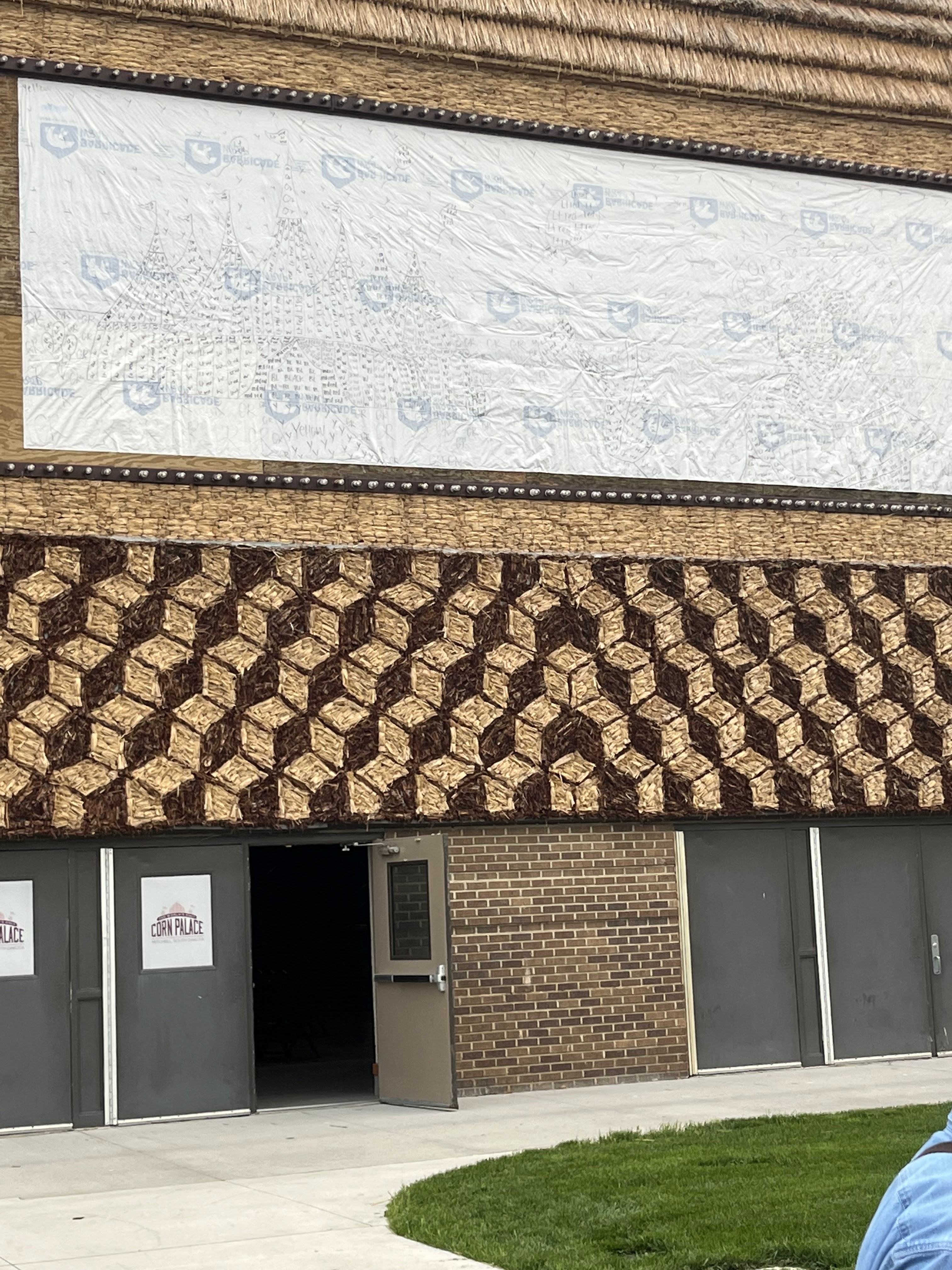
  • The palace is redecorated every year sporting a new theme.
  • 600,000 pieces of corn are used to decorate the outside of the building.
  • 3,000 bushels of grains and grasses are also used, including milo, rye and sour dock
  • Nine different colors of Indian corn are needed to create the pictures.
  • Over a ton of nails, staples and wire are used to fasten the corn and grasses.
  • Approximately $100,000 is spent each year for redecorating.
  • Cal Shultz, a local artist, has been designing the murals since 1977
  • The first corn palace was constructed in 1892 to show that South Dakota had a healthy agricultural climate.
  • The current building was completed in 1921. The first level had to be non-combustible. 


Our tour guide was the model for the clown. He is a Shriner and often wears a clown costume.


The inside of the building has a large meeting space that is rented out for local events.  All of the murals are made with corn and grasses. The room was set up for the graduation for the local high school 

It's not easy to see, but the designs for each mural are first drawn on paper, then projected on large sheets that are stapled to the building. The design shows what color corn is placed where.

They have pictures of the corn palace decoration for every year. 
The first Corn Palace was constructed in 1892. The Corn Palace was meant to show that South Dakota had a favorable agricultural climate. 

Even the girls got to see the building!

We also visited the Carnegie Library Building which houses the Carnegie Resource Center

Artist Oscar Howe painted the dome in 1949, and refurbished it in 1970

The building now houses a collection of Oscar Howe's paintings and an eclectic mix of local memorabilia including many Corn Palace souvenirs from years past. One side of the library has documents for local genealogy, including phone books, newspapers and school yearbooks through the years. 


Passing through Sioux City

Continuing on the Lewis & Clark trail: 


We stopped at a nice interpretive center in Onawa, Iowa on our way to Sioux City. The center had life-size models of Lewis & Clark's keel boat and pirogues. They were only rarely able to sail the crafts and often had to pole or row the boats. The decks have boards that you can see in the photo that would provide a brace for the men as they walked along the deck when poling the boats. I would simply trip on them and end up in the water!

The center had a few displays, one of the most unique was a painting of a keel boat with a rope and a meter that would show how many pounds of force you could create if you were "cordelling" a boat (towing a boat upstream). Often the water was too shallow for poling, rowing or sailing so the men had to cordelle the boats, sometimes wading through chest-deep water. 
Here I'm trying it by myself. In this picture I was able to get to 102 pounds of force! Probably wouldn't even nudge the boat forward an inch!

Four of us were able to create a force of over 1000 pounds for just a short bit. 
We decided we'd rather travel up the Missouri on roads in our RVs near the Missouri, than try to travel in it!

Later in their journey the party had to portage their belongings and canoes over rugged land covered in prickly pear cacti. 

The Corps took many items with them to trade with the Indians or to provide as gifts. 


While the expedition was near Pierre, SD a meeting with chiefs from the Sioux Nation (Dakota, Lakota, Nakota) went wrong. One of the chiefs was not pleased with the amount of tobacco he had been given and had it not been for the intervention of another chief, a fight could have ensued. Had that escalated, the expedition could have come to an end with loss of lives on both sides. 

Lewis & Clark carried the latest in tools to assist them with their work. This brass case held tinder, a piece of flint, and a striker to help in making a fire. The top also had a magnifying lens that could be used on sunny days to light the tinder.

The men journaled along the route, carefully recording details of their trip, mapping the river and lands, describing, sketching and identifying and/or naming plants and animals. This tin holding small candles and a fold-out stand was a portable light they could use in the evening, and fold up to store while they traveled. Their spelling was quite inventive! They apparently used the "whole language" approach! (Educators will understand that quip) Clark was supposed to have said he "wouldn't trust a man who didn't spell a word four different ways," and in his journals spelled had 19 different spellings for mosquitoes!


This was a portable writing case. It held two short quill pens and a tiny bottle of ink. Additional ink could be make from dried ink they carried. 
The picture in the background shows Seaman, a Newfoundland dog they purchased for $20 to go along with them on the trip. Seaman may have assisted in hunting, protection and in rescue.


Sergeant Charles Floyd was the only casualty of the expedition. He died near Sioux City, most likely from appendicitis. The men buried him on a bluff overlooking the Missouri River. A few years later his grave was moved by the local Indians as the water had undercut the bluff and his remains were in danger of sliding into the river. His remains were moved two additional times. He was finally laid to rest in 1900 on the bluff with a large monument installed to mark his grave. 


Saturday, May 20, 2023

Council Bluffs

Our Lewis & Clark journey.....


We went on to Council Bluffs where William Clark, himself, took us on a trip through the city and up onto the bluffs above the Missouri River. The bluffs were formed by loess,  a deposit of  yellow-grey silt and rock left by the glaciers and formed by the wind. The bluffs offer a sweeping view of the river and the city below. 

One intent of the Lewis & Clark Corps of Discovery was to learn more about the indigenous peoples along the route. There were at least 50 different Native American tribes on their route. The men would hold "council" with the Indians, and in a formal setting present them with a peace medal and proclaim that the Indians now had a new great father in President Jefferson.

The Lewis & Clark Monument in Council Bluffs


A view from atop the bluffs

We also had the opportunity to visit the Squirrel Cage Jail in Council Bluffs. This is one of three remaining jails of this sort, where access to a cell can only be gained by rotating the central section of the jail. This jail had ten pie-shaped cells on each of its three floors. Originally, the structure was moved by a hand crank. Later, a motor was installed. Over time, the building has shifted and the structure could no longer turn. 

Model of the Squirrel Cage Jail


Solitary Confinement "closet"


The jailer and his wife lived on the 4th floor. The jailer managed intake of prisoners and the wife prepared all of the meals. There were some additional cells outside of the cage for children or women.

Living room of Jailer's quarters


Tuesday, May 16, 2023

The Pony Express

The Pony Express began in Missouri in April 1860. The purpose was to carry mail back and forth to frontier communities between St Joseph, Missouri and Sacramento, California. 

The route was approximately 2000 miles long, had 190 stations where riders changed horses, or new riders took over the next leg of the trip. The mail could make the trip in about 10 days, and each rider generally rode 75-100 miles, using 5 to 10 different horses.

A map of the trail - a close-up view shows the express stations

In St Joseph, the rider would wait for the ferry to signal it was pulling into the dock.
Then, the first rider would head out to catch the ferry across the Missouri to begin their run to the west.


The saddles had a "mochila", a leather over-blanket  that had one or more pockets for the mail, and could be lifted from one saddled horse to the next in seconds. 

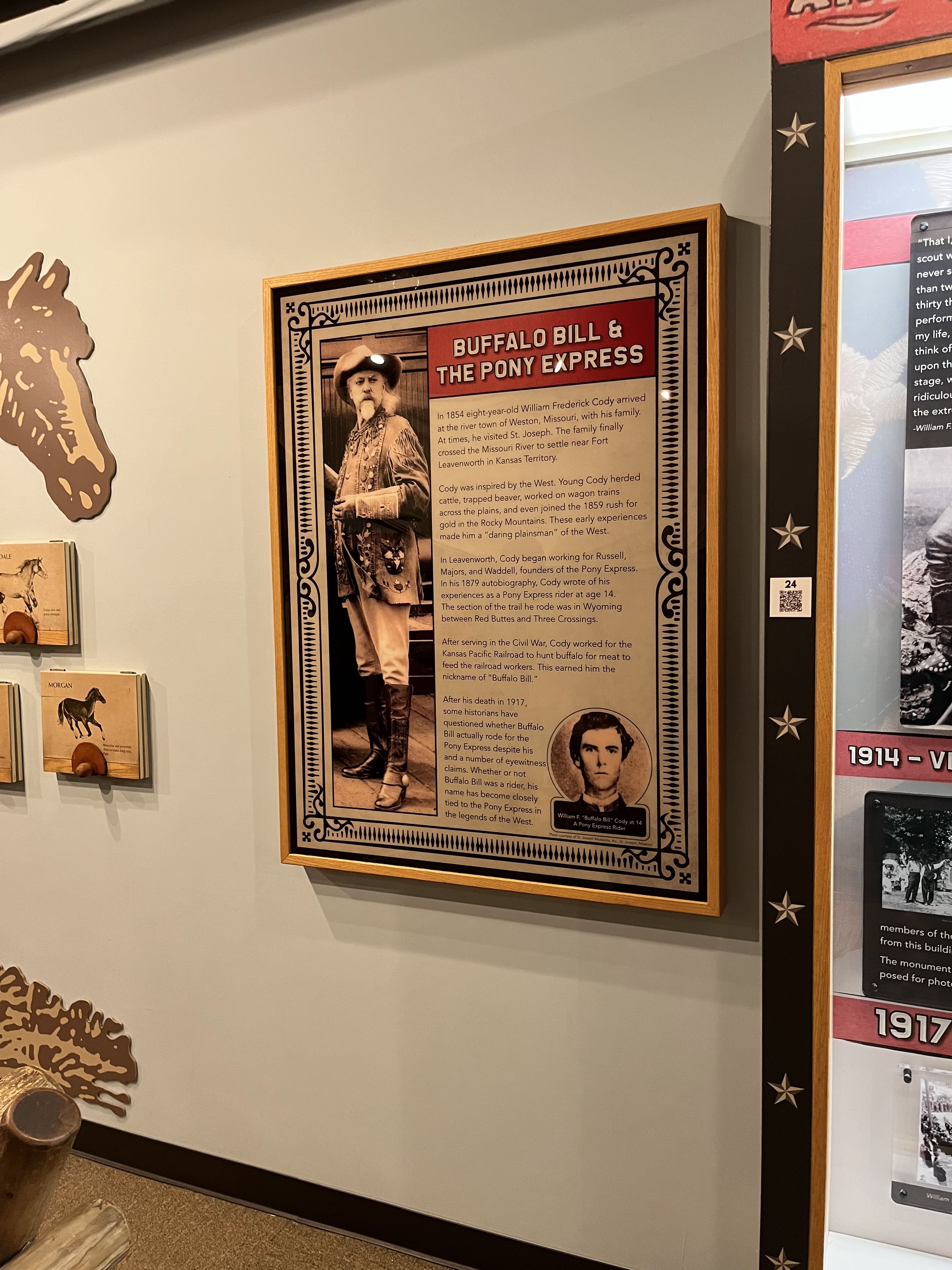
Buffalo Bill Cody reportedly rode for the Pony Express when he was 14.  He went on to memorialize the service and bring the Wild West to the public with his Wild West shows.


It cost $5.00 to mail a letter that weighed 1/2 ounce. 
Ouch! That was pretty expensive, even for today!
$5 in 1860's supposedly is equivalent to $180 today!


Eighteen months after the Pony Express began the transcontinental telegraph was completed and communication from one coast to another could be completed in a matter of minutes. The Pony Express was shut down.
 

Friday, May 12, 2023

Steamboat Arabia


While in the Kansas City area we visited the Arabia Steamboat Museum. I have to be honest and say that it didn't sound all that interesting. And, I have to confess that I was in awe of everything I learned and saw!

The Steamboat Arabia was built in Pennsylvania in 1853. The steamboat plied the waters of the Missouri River, carrying up to 222 tons of cargo, as well as passengers. The cargo included tools and equipment for settlers to the west, as well as goods for families that were settling there. On September 5, 1856, the steamboat hit a submerged snag, a fallen tree. It sunk within a matter of minutes. 150 passengers and crew made it safely to shore. The only casualty was a donkey that had been tied by his reins. The museum staff settled on the name "Lawrence" (of Arabia) for the mule. His bones are on display. The majority of the cargo was lost below the surface of the river. 


In 1988 an air conditioner technician serviced a unit for a gentleman in the Kansas City area who was enamored with sunken ships. It is said that David Hawley shared that enthusiasm with his brother, father and a restauranteur over lunch. (Greg Hawley, Bob Hawley and Bob Mackey. They used historical records to plot the historical position of the Missouri River, and possible locations of the lost ship. They used strong metal detectors and finally discovered what most likely was the 171 foot steamboat, 45' under a farmer's cornfield. They brought in a fifth member of the team, David Luttrell, the owner of a construction business. 

The group had a small window of opportunity to complete the excavation, taking advantage of the frozen ground in the winter months which also had less ground water. Regardless, they still had to have 20 very powerful pumps to keep water out. The men discovered, collected, cleaned and preserved the largest collection of pre-Civil War artifacts in the world. (They are still working on cleaning and preserving items.) The group decided not to sell anything from the collection, but to open a museum to share this treasure trove with the public. 

Here are just a few pictures of some of the displays of items that were in the cargo of the steamboat. I was amazed by the variety and quantity of items.


All of the items on display had to be cleaned, preserved and in some cases repaired. Wood items had to be treated with polyethylene glycol over a period of time. Leather items had to be cleaned and most often restitched. Cotton fibers disintegrate in water over a long period of time. The shoes and boots had to be put on forms and very slowly dried. Woolens survived, but cotton and linen did not. Some crates that had contained shirts were reduced to a mushy mess with buttons. Rust formed on metal objects had to be scraped off and buffed with erasers. 

There are still bins of frozen artifacts that have not been cleaned or preserved. Preservationists were working on items when we visited the museum. 

David Hawley, one of the team members discovering the steamship, was at the museum and came and talked to our group briefly. I was curious as to what the farmer thought about their interest. David reported that the farmer was intrigued (and had heard rumors of a buried steamboat previously) and allowed them to excavate the steamship, as long as it didn't interfere with his corn planting in the spring!


Sleepy Sunday

 Today was another hot day. Neither of us cared to do anything outside. I did tiptoe out to water a few wilted plants, but otherwise, stayed...