Saturday, May 20, 2023

Council Bluffs

Our Lewis & Clark journey.....


We went on to Council Bluffs where William Clark, himself, took us on a trip through the city and up onto the bluffs above the Missouri River. The bluffs were formed by loess,  a deposit of  yellow-grey silt and rock left by the glaciers and formed by the wind. The bluffs offer a sweeping view of the river and the city below. 

One intent of the Lewis & Clark Corps of Discovery was to learn more about the indigenous peoples along the route. There were at least 50 different Native American tribes on their route. The men would hold "council" with the Indians, and in a formal setting present them with a peace medal and proclaim that the Indians now had a new great father in President Jefferson.

The Lewis & Clark Monument in Council Bluffs


A view from atop the bluffs

We also had the opportunity to visit the Squirrel Cage Jail in Council Bluffs. This is one of three remaining jails of this sort, where access to a cell can only be gained by rotating the central section of the jail. This jail had ten pie-shaped cells on each of its three floors. Originally, the structure was moved by a hand crank. Later, a motor was installed. Over time, the building has shifted and the structure could no longer turn. 

Model of the Squirrel Cage Jail


Solitary Confinement "closet"


The jailer and his wife lived on the 4th floor. The jailer managed intake of prisoners and the wife prepared all of the meals. There were some additional cells outside of the cage for children or women.

Living room of Jailer's quarters


Tuesday, May 16, 2023

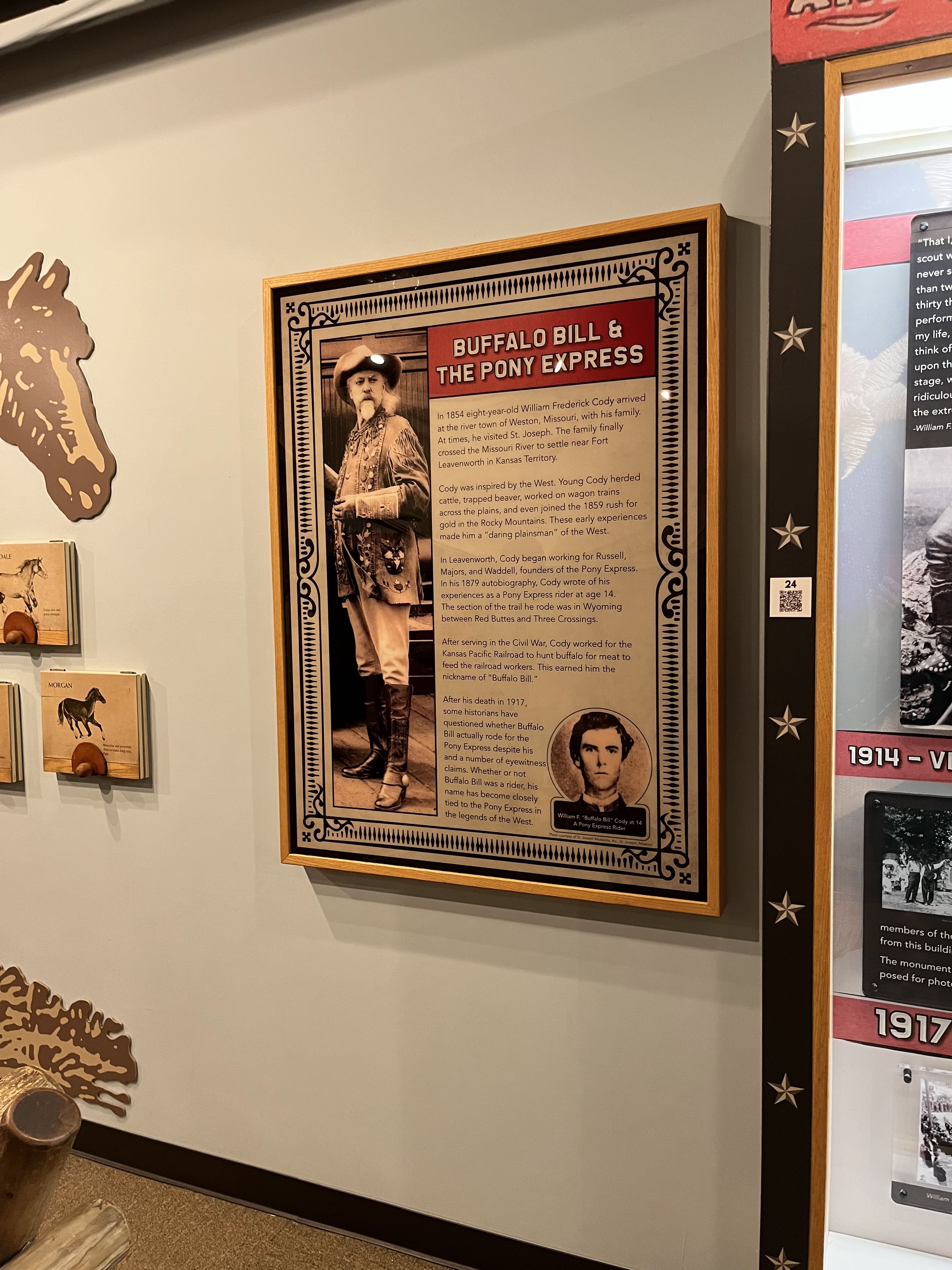
The Pony Express

The Pony Express began in Missouri in April 1860. The purpose was to carry mail back and forth to frontier communities between St Joseph, Missouri and Sacramento, California. 

The route was approximately 2000 miles long, had 190 stations where riders changed horses, or new riders took over the next leg of the trip. The mail could make the trip in about 10 days, and each rider generally rode 75-100 miles, using 5 to 10 different horses.

A map of the trail - a close-up view shows the express stations

In St Joseph, the rider would wait for the ferry to signal it was pulling into the dock.
Then, the first rider would head out to catch the ferry across the Missouri to begin their run to the west.


The saddles had a "mochila", a leather over-blanket  that had one or more pockets for the mail, and could be lifted from one saddled horse to the next in seconds. 

Buffalo Bill Cody reportedly rode for the Pony Express when he was 14.  He went on to memorialize the service and bring the Wild West to the public with his Wild West shows.


It cost $5.00 to mail a letter that weighed 1/2 ounce. 
Ouch! That was pretty expensive, even for today!
$5 in 1860's supposedly is equivalent to $180 today!


Eighteen months after the Pony Express began the transcontinental telegraph was completed and communication from one coast to another could be completed in a matter of minutes. The Pony Express was shut down.
 

Friday, May 12, 2023

Steamboat Arabia


While in the Kansas City area we visited the Arabia Steamboat Museum. I have to be honest and say that it didn't sound all that interesting. And, I have to confess that I was in awe of everything I learned and saw!

The Steamboat Arabia was built in Pennsylvania in 1853. The steamboat plied the waters of the Missouri River, carrying up to 222 tons of cargo, as well as passengers. The cargo included tools and equipment for settlers to the west, as well as goods for families that were settling there. On September 5, 1856, the steamboat hit a submerged snag, a fallen tree. It sunk within a matter of minutes. 150 passengers and crew made it safely to shore. The only casualty was a donkey that had been tied by his reins. The museum staff settled on the name "Lawrence" (of Arabia) for the mule. His bones are on display. The majority of the cargo was lost below the surface of the river. 


In 1988 an air conditioner technician serviced a unit for a gentleman in the Kansas City area who was enamored with sunken ships. It is said that David Hawley shared that enthusiasm with his brother, father and a restauranteur over lunch. (Greg Hawley, Bob Hawley and Bob Mackey. They used historical records to plot the historical position of the Missouri River, and possible locations of the lost ship. They used strong metal detectors and finally discovered what most likely was the 171 foot steamboat, 45' under a farmer's cornfield. They brought in a fifth member of the team, David Luttrell, the owner of a construction business. 

The group had a small window of opportunity to complete the excavation, taking advantage of the frozen ground in the winter months which also had less ground water. Regardless, they still had to have 20 very powerful pumps to keep water out. The men discovered, collected, cleaned and preserved the largest collection of pre-Civil War artifacts in the world. (They are still working on cleaning and preserving items.) The group decided not to sell anything from the collection, but to open a museum to share this treasure trove with the public. 

Here are just a few pictures of some of the displays of items that were in the cargo of the steamboat. I was amazed by the variety and quantity of items.


All of the items on display had to be cleaned, preserved and in some cases repaired. Wood items had to be treated with polyethylene glycol over a period of time. Leather items had to be cleaned and most often restitched. Cotton fibers disintegrate in water over a long period of time. The shoes and boots had to be put on forms and very slowly dried. Woolens survived, but cotton and linen did not. Some crates that had contained shirts were reduced to a mushy mess with buttons. Rust formed on metal objects had to be scraped off and buffed with erasers. 

There are still bins of frozen artifacts that have not been cleaned or preserved. Preservationists were working on items when we visited the museum. 

David Hawley, one of the team members discovering the steamship, was at the museum and came and talked to our group briefly. I was curious as to what the farmer thought about their interest. David reported that the farmer was intrigued (and had heard rumors of a buried steamboat previously) and allowed them to excavate the steamship, as long as it didn't interfere with his corn planting in the spring!


Kansas City Here I Come

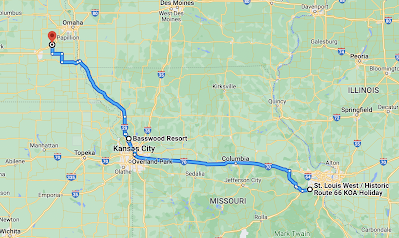
We traveled mostly on secondary roads from St. Louis to Columbia, MO, following the directions given to us by Adventure Caravans. There wasn't a lot to see: farm lands, narrow roads, an occasional glimpse of the Missouri River, for example. 

However, we did go through Bluffton, MO. There wasn't a lot to see! Bluffton used to sit on the bluff of the Missouri River, but the river's course has changed over the years. From the road all I noticed was a mailbox in front of a home for the Bluffton Barn, which is apparently a B & B that is often used by hikers on the Katy trail (Missouri, Kansas, Texas Railroad trail), and a street sign for Bluffton Rd. 


At one point we could see the dome of the Missouri State capitol building in Jefferson City in the distance. 

We arrived at the next park in Platte City, MO. We had bus tours into surrounding areas over the next 3 days.

Our first trip included an historic tour of Kansas City, MO. We began at Union Station, which is the 2nd largest station in the US, with only NYC being larger. I enjoyed seeing the older buildings, many of which are being renovated as young adults are moving into the city. 


Webster School opened in 1885 and served kids until th 1930's. It was a restaurant with boutique shops on the first floor until the pandemic. I had the opportunity to eat there two times!

Art Alley

World War I museum.

Historic TWA building with Moonliner II on the roof
Lewis & Clark Mural

Another shot of the Lewis & Clark Mural

Country Club Plaza, the first planned suburban shopping center.
It opened in 1923.

Children's Mercy Research Institute - the off-color window spell out the DNA sequence of cancers that some of the young patients have had. At night the sequence glows in LED colors.

The Meyer Circle Horse Fountain, one of more than 200 fountains in the city.
Kansas City is known as the "City of Fountains" having more fountains than another city except Rome.

Murals celebrating Negro League baseball players

Kansas City Statehouse

Kauffman Center for Performing Arts. The roof shimmers and the points of the building are reminiscent of the Sydney Opera House.

Plantaes Seed & Spice Shop in the Historic City Market. The store opened 100 years ago and still has the original squeaky wood floors and drawers for bulk seed. 


Monday, May 8, 2023

Let the Caravan Begin: St Louis

 Our Adventure Caravan trip began in St. Louis, MO. 15 RV's came together at the rendezvous campground in Eureka. Lewis & Clark set out from St Louis in 1804 to explore the Louisiana Purchase and determine if there was a passage to the Pacific Ocean. They began by moving upstream on the Missouri River. They had a tough time of it! 

We, however, enjoyed nights in our RV's and bus trips into surrounding historic areas. 


We are at the beginning of the trail at Camp Dubois

Lewis & Clark and Seaman, the Newfoundland

Cathedral Basilica St Louis
The mosaics are unbelievable! 


Anheuser-Busch Headquarters in St Louis


One of the original buildings of a Bavarian brewery, built in 1890

Reynard the Fox sits on the four corners of the bottling plant.
He became the mascot for Bevo, a non-alcoholic beer produced during prohibition. Anheuser-Busch managed through prohibition by producing Bevo and by selling Brewer's Yeast, which also had a recipe for beer on the label!

Amazing tiles in the bottling plant - notice Reynard!

An elephant sits atop of one of two stone pillars. They also date back to prohibition and were symbols of the ice cream that Anheuser-Busch also produced. Elephants were also used on malt liquor labels.

Brewing plant - such beauty

Another shot of the brewing building showing the "hops" chandeliers that were ordered before the World's Fair

Loved how the 6' "safe" distancing was described

One of two Clydesdales on display in the stables

Goofing off - couldn't resist the sign which was placed near a clarifying tub, which was the real photo op

Among the many interesting buildings in St Louis was this "Artichoke" building

Union Station Hotel

More of Union Station.
I sometimes forget that trains were one of the major forms of transportation "back in the day". Large train stations were the norm in growing frontier cities.

When in St Louis one has to see the arch. We have seen it from the road on numerous trips going back and forth across the country. 

A view from above the visitor's center

Looking down on the visitor's center, and the city to the west, from atop the arch.

We took a bus trip to Daniel Boone's Home. 
The home actually belonged to his son, Nathan, but it is where Daniel Boone returned when he knew he was dying.

It's hard to imagine that this 4-story home was built in early 1800 on the edge of the wilderness

Other historic buildings have been brought to the Defiance, MO site of the Nathan Boone home.


The Nathan Boone home has a basement kitchen and dining room. The main floor has a large drawing room and two other rooms on the other side of a central hall. Daniel Boone is said to have died in one of those rooms.

Upstairs there are two large bedrooms on either side of a central hall. Nathan and his wife slept in one of the rooms, and the children slept across the hall. Of course, I had to take pictures of the quilts on the bed, which weren't original to the home, but were representative of the time. We were told the top floor was where dances were held.


We went on to St. Charles, Missouri
The historical street is lovely, with many old buildings and is thriving with many restaurants and shops. Our favorite building was just off Riverside Drive. It is a vertical log church (reproduction) from 1791


We also visited the Lewis & Clark Boat House & Museum. They have replica pirogues and a keel boat that have been used in reenactments, part of a National Park Service museum. 


Rainbow of Colors

Who doesn't like a new box of crayons?  Those prefect, shiny points; That distinct, memorable crayon smell! A side note: schools, teache...