Wednesday, March 9, 2016

Yuengling

It is patently obvious that I am not a beer connoisseur. Also obvious that I don't ever (rarely) walk down the beer aisle at the market. Although my father-in-law drinks Yuengling, I never realized that it is only available on the east coast.


Yuengling is the oldest brewery in America, having been established in 1829 in Pottsville, PA, and it is one of the largest breweries by volume in the U.S.  It's name, pronounced "ying-ling" is the anglicized version of Jüngling, the last name of its founder. Jüngling emigrated to the U.S. from Germany and began the Eagle Brewing Company in 1829. The name of the brewery was later changed to Yuengling. (An interesting side note: Anheuser-Busch (founded in 1852) sued Yuengling over its use of the eagle as its trademark. The claim was thrown out by the judge, as it was obvious just which brewery used the eagle first!)


Our group toured the Yuengling brewery in Tampa, FL. Coincidently, it is practically next door to Busch Gardens, where Anheuser-Busch brewed beer until the mid 1990's. I enjoyed the Yuengling tour, although as it was Friday afternoon, the weekly quota had already been met so no brewing or bottling was going on. Our tour guide was wonderful. She shared so much information, and so many numbers, my mind was reeling by the time we left. If you are interested in learning more, she recommended this video about Yuengling Brewerieshttp://youtu.be/L_tSYIr9OCU


The tank seen in the back of this picture is in the older portion of the brewery, where the mash was separated from the wort. This section of the brewery is no longer used. (Yuengling purchased the facility from Stroh, and it was previously used by Schlitz and Pabst.)


Here are the new tanks in the brewery. They were being serviced while we were on tour. The new section of the brewery is managed by computer. There is much less "hands-on" work involved in brewing with the new equipment.


The white tanks contain barley. I can't recall the exact amount, but they will go through all of this barley in a very short time. 


Barley comes in by the trainload. Pelleted hops from Washington arrive in huge burlap bags by truck load. 


The bottling line is in the center of this picture. Canning is completed on the right. One interesting fact... beer is usually bottled in cans or dark brown bottles as it is light-sensitive. Beer should be stored in dark places. Some beer is bottled in green glass. Exposing this beer to sunlight for even 15 minutes will impact the flavor of the beer!


Now it's time to taste the beer. I discovered that I like "Black and Tan". This beer is a mixture of Porter and Yuengling Premium beer. 

Another interesting tidbit...during prohibition Yuengling survived by branching out. They purchased some dairies and produced Yuengling ice cream. Our guide said the ice cream will be coming out again. Look for it in your grocery store. If distribution is anything like their beer, it will only be available in states along the east coast. 


Thomas Edison and Henry Ford - Snow Birds!

In the late 1880's Thomas Edison was fishing on the Caloosahatchee River near Fort Myers, Florida. He noticed a "For Sale" sign on the banks of the river. Edison toured the property which at that time only had a small cottage on it and noticed a stand of bamboo growing there. Bamboo is not indigenous to the area so he decided this was a sign that he should purchase the property since bamboo strands were what he used for the first successful filaments for his lightbulb.
Building a winter cottage on the property was no easy task. There were no roads or railroads into the area so Edison had to have all of the building materials shipped from the north and brought around the tip of Florida and up the Caloosahatchee River. The first thing Edison did was to construct a pier for docking the ships and unloading the building materials. The pier went out into the river 1500 feet to where the water was deep enough  for the ships to come in. 


Edison built two homes on the property with separate kitchens and nice breezeways. Both of the homes had large wrap-around porches to take advantage of the breezes and the view. The second home was to be purchased by one of Edison's friends and coworkers. Edison found out that he had been swindled by this fellow so he kept the property and used it as a guest cottage. 


The furnishings in the homes are all original to the time when Edison lived in the home. After Edison's death, his wife eventually gave the property to the city of Fort Myers with the instructions that everything in the house must stay as it was when Edison lived there and that the house be open to the public for educational purposes. 


Edison worked for Henry Ford for a period of time and they became good friends. Ford tried to convince Edison that he needed cars at his new home in Florida. Edison agreed to have cars if Henry Ford would build the garage for them. The caretakers cottage, the original home on the property, now has a three-bay garage that housed Edison's cars. 
Edison convinced Ford that he should buy the house on the adjacent property. Ford purchased the home, had a remodeled, and of course added some garages for his automobiles. When Ford died the property was sold and the furnishings were auctioned off so today you can see the home and the property with period pieces that are similar to what might have been in the home.
I was fascinated by the trees, shrubs and flowers throughout the property. Edison had plants flown in from all around the world. Some were brought in as Edison attempted to find additional sources for rubber, after all, his automobiles needed rubber tires. Rubber was a precious commodity, and the US was dependent on outside sources for the product, especially during the war years. 


He never found a plant that would provide cost effective means to make rubber, and the development of a synthetic rubber product by DuPont made further research unnecessary. There are still many banana plants, fig trees and even orchids that were brought to the property by Edison.


This was a single 4" fig tree when Edison planted it in 1927. It is also called a Banyon tree. The branches send out air roots. They root themselves when they reach the ground, and eventually grow together and become sturdy supports for the tree. The Banyon tree was planted as part of Edison's quest to find rubber . It gives off a milky sap that can be used to make latex. 

Edison's houses both underwent major renovation recently. Much of the wood had to be replaced. The wood that was used to construct the homes came from the northeast U.S.  The lumber was a soft pine and not suitable to the damp climate and termites. Southern pine is much more dense, and many southern woods resist insect damage. 

Sunday, March 6, 2016

From the Horse Capitol to the Sponge Capitol

I'm We visited Tarpon Springs and discovered that we were in the Sponge Capital of the World. In a way, I also felt like I had been transported to the isles of Greece. That could be because sponge divers from Greece were recruited in the early 1900's to bring diving with a suit and helmet to the area, instead of hooking sponges with a three-pronged fork from the boat. It revolutionized the sponge industry, allowing sponges to be harvested from deeper water, and using a larger boat that could carry more sponges. Now, the town of Tarpon Springs has more residents of Greek descent than any other city in the U.S.  There are numerous Greek restaurants (we ate at Dimitri's On The Water) and you can hear folks speaking Greek on the streets.

This is a typical sponge boat of the original Greek design. This particular boat was retired in 2007 and was used to harvest sponges for 75 years!


We took a ride on an authentic sponge boat to learn more about the process. Max, (the only non-Greek crew member on the boat), wore the historic type of dive suit made of a canvas and rubber sandwich.  He wore "shoes" of leather and metal. Below are a few shots of Max retrieving a sponge.


The sponge is an animal. When they are harvested they are covered with a gelatinous substance, which is the actual animal. The sponge as we know it is the skeleton of the organism. Once harvested the sponges are trimmed of rock or coral where they had attached themselves to the sea floor, and are then stacked on deck and covered with burlap, which is kept wet.  Periodically the sponges are squeezed, rotated, and re-covered. It takes four days to process the wool sponge, the finest sponge and one found only in the Gulf of Mexico. Our boat captain said the stench is unbelievable! Some of the other varieties of sponge don't take as long to process. Once the soaking process is complete the sponges are cleaned in a peroxide solution and strung on ropes to dry. Merchants buy the strings of sponges and further clean them and cut them into convenient sizes. 

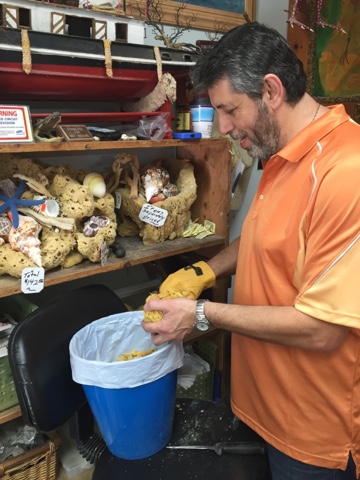
One of the Greek shopkeepers was trimming sponges in his shop. He recently moved from Greece, and commented that he had never seen a sponge before arriving here!


There are many shops selling sponges in town.


Following our tours we enjoyed Greek fare, beginning with Saginaki (flaming cheese).

Opa!
(Urban Dictionary: a word that Greek people use for no apparent reason at all!)


Yum!


A heron outside the restaurant looks in to see if he can have some. (Isn't he cute?!) Sorry, buddy, no Saginaki for you!


Please? Maybe a taste of your calamari? 


Mmm Mmm Money

I'm in love. 


Well, to tell the truth, I've been here before and I felt the same way every time I visited.


How could a horse-crazy teen/adult/senior not be in love with the "Horse Capitol of the World", Ocala, FL?


On Thursday we had a bus tour through some of the large horse farms in Ocala. The largest we saw, but not the biggest game in town, was the Live Oak Stud Farm owned by "Mmm Mmm Good" Campbell Soup heir, Charlotte Weber. Our bus traced the boundaries of the farm, all 4500 acres of it! 
Notice the bronze statues of horses running in front of the barn!
We rolled past double-fenced pastures. Some with mares and foals, a few with yearlings, some with mares lumbering toward the fence to see us, with distended bellies, ready to foal any day. We drove by beautiful barns, practice tracks, quarter horse farms, enticing entrance gates, arenas with lovely, colorful jumps, and dressage arenas.


Ocala has more horses, per capita, than any other area in the world. (However, The Lexington area of Kentucky may have more thoroughbreds.) There are farms that focus on breeding, and sell their horses as yearlings or two-year olds, and other farms that focus on training, often buying promising youngsters to train and either race, or sell for others to race. Many of the horses are sold, locally and internationally, at OBS, Ocala Breeders' Sales, a large huge complex in the area. I found it fascinating that the airport, across the street from OBS, is used for private planes. However, there are commercial airlines that come in to fly horses to their new homes!


The bus dropped us off at Kimberden, a show stable in Ocala.  We enjoyed lunch on the patio, between a groomed arena with jumps and an immaculate barn, each door draped with carefully folded horse blankets and graced with lovely, matching tack trunks in front. They have a great boarding/training package, so I was told. I could keep my horse there for $2000 per month. Yes, it sounds steep, but boarding includes three lessons, or three training sessions a week.
We enjoyed a wagon tour of some neighboring farms pulled by matching black Percherons, Duke and Doc.  The horses were stars in Pirates of the Caribbean! 
(Experiencing maddening technical difficulties and can't load pictures of the horses 😜)

Thursday, March 3, 2016

Time Machine

Before leaving the Tallahassee area we took a quick trip up to Felkel, Fl to buy some sausage at Bradley's Country Store. 


Mrs. Bradley began selling sausage out of her home in 1910, and the building we visited was constructed in 1927. The shop had a little of this, and a little of that. Truly a trip back in time. 


And the sausage? 
Yum!

The Name Game

I am the self-appointed Poet Laureate for Adventure Caravans! It began as a lark on our first tour with the company. I was having so much trouble remembering who was who that I began to make up rhyming couplets to help me make connections. That led to a finished poem that I shared with the group. A staff member from that tour was on our next tour, and asked if I'd do another poem. This time, one of my fellow travelers asked, having been with me on the previous tour. So, here is the introductory poem for our trip:

Here we are at the start of our tour.
It's time for a poem you'll have to endure!
This is something I'm compelled to do,
Writing silly rhymes that might entertain you. 
This is my way to learn your names,
And maybe remember from where you came.
I'll begin with me. I'm Cyndi. I'm married to Scott.
We live in Colorado but we travel a lot.
Ron and Mary, as well as Gayle and Wes
All came from the Lone Star State of Texas. 
Mary and Ron camp in a white Excel
Mike and Sylvia have one as well.
Mike's the Marine with very little hair.
He wears a cap to cover what's missing up there.
Not to be confused with the Mike, who's with Jan
Who used to be a newspaper editor man. 
They are in the van that is so ti-ny,
And come from California, like Karen and Speed.
We have some other folks who travel small;
I'm trying to figure how Ceil, from Michigan, carries it all. 
Have you seen all she carries in her little rig?
She even has a small fire pit and one that is big. 
Fran lives full-time in just twenty-four feet,
She must be an expert at keeping things neat. 
She is a walker, striving for 10,000 steps every day,
While Gayle finds timing her walks is the easier way. 
Marie's little Tiger probably lives up to its name;
She camps near Seattle where the roads aren't so tame. 
Drew's from Ontario, he's our Canadian rep,
Replacing his oil cap will be his next step. 
He had some misfortune on yesterday's ride,
But arrived in good humor, taking it all in stride. 
The trailer with the pointed front is Karen and Speed's.
They came from California where their farm has trees.
In the Winnebago Vectra you'll find Judy and Dell,
They have spent time in California as well. 
Judy does crafts, as several of us do,
And Dell checks his ancestors to find out who's who.
John and Joyce, Michigan campers of the year,
Live on the road for six months and volunteer. 
I forgot to mention that Ron, Mary, and their dogs
Are working to mark off every state in their log.
Sandy, Barbara and Jim we haven't met,
I don't know what to say about them yet. 
Bill and Carol, from DC, have staffed caravans since 08.
Just imagine what they've seen in so many states. 
Our tail gunners, Jim and Cherrill, always come last,
Stopping to help rigs that the rest of us pass.
There you have it, that's our little group.
I'm looking forward to all that we'll do.
We will have more adventures as we caravan,
Exploring this little corner of our wonderful land. 


        Relaxing after our day exploring Tallahassee.


Wednesday, March 2, 2016

If it's Tuesday, it must be Tallahassee

Tuesday we toured Tallahassee, Florida's Capitol (with an "o" our tour guide reminded us)! After a bus tour around the city, and, might I add, what an amazing job our driver did at negotiating narrow streets and tight turns with a 45' bus, we stopped at the Florida's Historic Capitol Museum. 

I wasn't prepared to enjoy this museum as much as I did!

The building has been returned to how it stood in 1902. The structure was initially constructed in 1845, and had the dome and cupola installed in 1902. Large wings were added as the government grew.  A larger structure was built basically surrounding the original building and its additions in contemporary times. The wings of the older building were removed as they presented a fire hazard, and restoration was begun. The museum had some great exhibits and photos. The chambers for the Senate and Representatives stand as they did in the early days, and the wall sconces and chandeliers (electroliers) are original to the building, with electric lamps on the bottom and gas lamps on the top. In the early times of electricity, they only had power four hours each day!

The awnings were used "back in the day" to help keep the building cool. 

Senate Chamber

Representatives


This mosaic was installed under the rotunda in 1953. It was removed when the building was restored to its original linoleum floors, and placed on display elsewhere in the building.


Looking toward the Supreme Court building in Tallahassee with part of "Stormsong",  a crescent of leaping Dolphins that graces the steps of the Capitol.


Our next stop was at the Museum of Florida History. This museum traces Florida history from its earliest cultures up to modern times. There are interactive exhibits, video and audio presentations and so much to see. Allow several hours! We didn't, and didn't get to study it all!

The day was truly a capitol(sic) experience!


Harbor Springs

 We were told by quite a few folks that we must go visit Harbor Springs, MI while we were in the area. Wednesday, or last day in town, was p...