Showing posts with label winery. Show all posts

Thursday, August 30, 2018

3,072 Bottles of Wine in the Box


Do you recall that wonderful "I Love Lucy" episode at the chocolate candy factory? The one where Lucy and Ethel can't keep up with the candies coming at them on the conveyor belt. I worked with seven other people recently to bottle wine. We all commented that we felt like we were on that episode, but with wine bottles. As much as we would have liked to have tucked some bottles here and there to speed up the process, it just wouldn't work!

We have become members of a local winery. One of the benefits of membership is that we can go to their tasting room, a convenient mile from our home, and have a free glass of wine. Many evenings we ride bikes to "Rigger's Loft" to enjoy our free glass, then head home for dinner. Members received an email inquiry asking for help bottling. We both decided it sounded like it would be interesting. So, Wednesday morning found us at the loft, ready to learn what we were to do.


There were seven stations in the bottling process.

Station 1. Bottles are dropped onto a table by the case. If you hold the carton by the corners, and place it open side down,  you can lift the carton off the bottles and most of the time the cardboard grids stay in the carton. The cartons are piled on the floor and will be taken to the other end of the line to be filled with full bottles of wine. The bottles have to be "sparged". A quick jet of nitrogen is blown into each bottle using a hand-held tool similar to a tire inflater. The jet of nitrogen blows any dust in the bottle out, and stays at the bottom of the bottle keeping any contaminated air out of the bottle.


Station 2. The filler grabs each prepared bottle and pushes it up to a nozzle. On this particular machine there were six nozzles. A long 2" diameter hose runs from the tank to a hopper at the top of the filler. The wine is gravity fed through each nozzle into the bottle. If the filler is set up correctly, wine will stop flowing at the exact "full" point.  (At first we had some problems with too much wine in the bottles... the corks were not going in all of the way.) When the bottle is full, the filler lifts it out of the nozzle and puts it on the table.


Station 3. The corker operator (that was me for quite a while) grabs the full bottle with his/her right hand. It is pressed into a "V" in the machine which has a switch that activates a piston, driving the cork into the bottle. The bottle is then lifted out with the left hand and put on the next table.

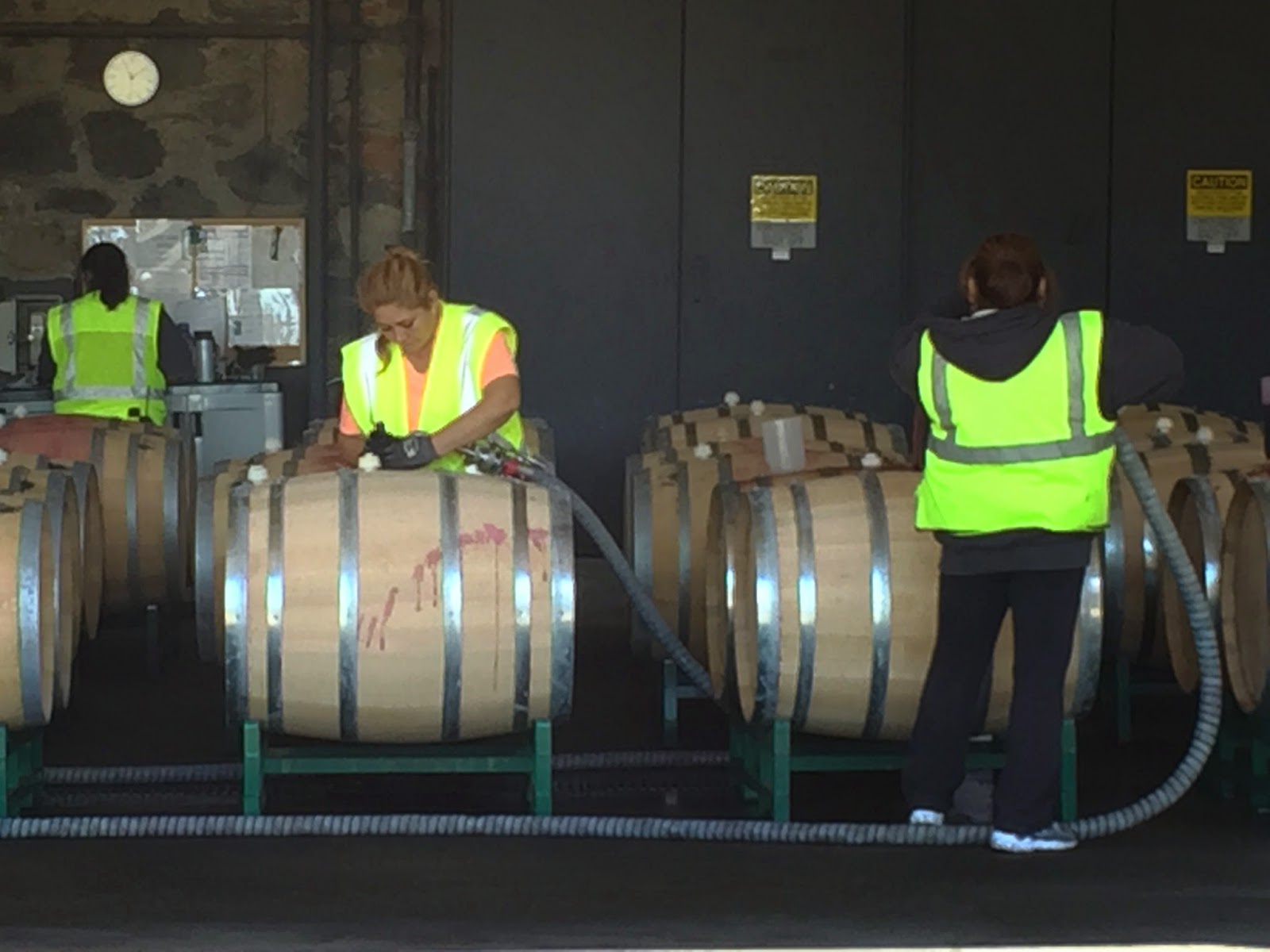
Sparging going on in the background. Bottles waiting for corks in the foreground
If the bottle is a bit too full, a tablespoon or so is poured into the pitcher.
Station 4. The foiler places the foil cap over the top of each bottle. No machine is involved! It sounds simple, but this is one place where we would run into a bottleneck (I just had to use that term!!) The foil caps are nested, making a long tube, and it takes some finesse in getting just one cap off.

Station 5: The foil shrinker grabs a bottle with the right hand and places it on the platform of the machine in a V made by two pieces of wood. Then the operator must use both hands to push two buttons. The machine lowers over the neck of the bottle and emits heat and pressure which shrinks the foil. When the machine lifts, that bottle is placed on the table to the left and the next bottle on the right is placed on the bed of the machine.


Station 6: There were two bottle labelers. Bottles were picked up and placed on the first labeler, or passed on to the second labeler. Once the bottles were in place, lying down on the machine, a foot pedal was pressed and the bottle rolled as labels for the front and back stuck to the bottle. Bottles were placed on the last table.


Station 7: Full, labeled bottles of wine were placed in the cartons which had been emptied at the first station, and carried down to the end of the line. Once 12 bottles were in the carton, it was taped shut and placed upside down on the pallet... which was actually right-side-up as far as the box label went. Each pallet held four layers of 16 cartons of wine. That's 768 bottles... and each person touched each bottle at least once, sometimes twice! During the entire day 4 pallets were filled... 3,072 bottles of wine!

A few rejects have been set aside. The labels will be scraped off  before new ones are applied. 
 We had a wonderful time. We were tired, but it was fun to be part of the team. Certainly there are larger operations with more automation, but this system works for this small winery. Will we do it again? Certainly!


Tuesday, October 14, 2014

Name Dropping

So, there I am, touring the Simi Winery with Mr. Dreamy. We had an excellent tour of the facility. This original building was constructed around 1875. The left side of the building was constructed first, using local stones and mortar. After an earthquake, bolts were added to keep the building stable in future earthquakes. Later, using different laborers and materials, the right side of the building was constructed. You can see a difference in the rock. This side of the building was stabilized with an ingenious method using reinforcing rods inside.


Another neat thing about the building is that the founding Simi brothers dug into the hillside, since there were no caves like they were used to in Italy, where they first learned the wine making craft. This would naturally keep the fermenting wines cooler.


Yup, here we Dreamers are… 
looking happy as we think about the free tasting to come!
(Or perhaps we are looking happy having just come from another tasting!)


The tour was fascinating. I enjoyed learning about the historic winery in the Alexander Valley in wine country, USA.  Our tour guide took a moment to trace the ownership of the winery, from the Simi brothers...


 to daughter, Isabelle…

to "a company in New York."

My mind stewed on that for a minute or two (or maybe five), as the tour guide went on. He was talking about something else when I had to ask him to back up. 

"That company in New York," I inquired, "is that in Canandaigua, NY?"

"Yes," he acknowledged, "Constellation Brands."

"No kidding!" I said, possibly with my jaw hanging open a bit.

It turns out I know the Chairman of the Board of Constellation Brands.
Well, I knew him… way back when!

He's standing behind me in this graduation picture!
(You'll have to figure out which one!) 


Who knew?!

Sunday, October 12, 2014

Putting the Bubbles in the Bottles

Our group had a tour of the Korbel Winery, which has been producing wine on this site in Sonoma County, CA since 1882. 


Here we learned the fascinating story of the founders, three Bohemian (Czechoslovakian) brothers, as well as learning more about the process of creating "champagne style" wine. (The folks in the Champagne region of France took exception to other effervescent wines bearing their name! Producers outside of the region must identify their product in a slightly different manner, thus Korbel creates "California Champagne" or "Russian River Valley Champagne") 

Here is our group standing outside the ivied walls of the original building. The tower in the background is identical to a tower in which Francis Korbel was imprisoned after firing a shot in an uprising against the Government in Prague. He and his family had an interesting past!


The large, original casks were created on site in the cellars.
Currently Korbel uses only small oak barrels for fermentation
of their finer wines.


After fermentation the wine is bottled and capped, using a cap similar to that on a beer bottle. The bottles are stored for varying periods of time. The candle shows how the vintners lit their cellars where bottles were stored, prior to electricity.


After the fermentation process is complete the bottles are moved to riddling racks. Here the bottles are held at a downward angle. Vintners shook and turned each bottle several times a day. Adolf Heck, Korbel's second owner, created the first automated riddling rack. Riddling causes the sediment to move into the neck of the bottle.


The machines pictured below are those that were originally used to finish the bottling process. Following riddling, the neck of the bottle is held in a slurry of salt and ice to freeze the sediment plug. The temporary cap of the bottle is removed and the sediment plug is pushed out by pressure created by the slightly warmer contents of the bottle. (There are no bubbles in the wine at this time.) A mixture of wine and additional sugar is added to the bottle. The sugar encourages fermentation to begin again, causing the build-up of carbon dioxide, and this is what makes the 'champagne style' bubbles. Each type of wine has a different "dosage" (pronounced with a French accent, like dressage). The dryer (Brut) champagnes have a small amount of sugar added. We tasted one with a dosage of 1. It was almost lip-puckering dry. The sweetest variety I tried (and liked) had a dosage of 6.5. It was much sweeter. The French have high opinions of their process, which is (as I understand it) the same thing that is used to create bubbles in lowly beer!


Once the dosage has been added, the bottles are corked. If you have ever had Champagne, or a 'Champagne style' wine, then you are familiar with the cork, which is different than that used in regular wines. The cork is much wider in diameter, and before it is pressed into the bottle, the diameter of the cork is the same along its entire length. The corking machine compresses one end of the cork and it is driven part way into the neck of the bottle. The upper portion extends over the lip of the bottle and is held in place with a wire cage. This helps seal the bottle more effectively than a traditional cork. 

There are other means of adding bubbles to wine, including simply adding carbon dioxide in the final bottling or performing a secondary fermentation in the tank and bottling it under pressure.

I have included a video we saw at the winery that reviews the history of Korbel. 


Friday, October 10, 2014

Wining

The Sonoma and Napa Vallies are all about wine. The climate, warm days and cool nights, yields grapes with superior flavor. There are many tasting rooms, some at the wineries, others off site, where one can wine a bit. 


Some wineries also offer tours. Simi Winery was one of those.

Simi is an older winery, having begun in the late 1800's by two Italian brothers. The first brother came to America to seek his fortune in gold. That was hard work! He opted to sell produce to restaurants, and began making some wine in the cellar of his San Francisco shop. His wine was very popular so his brother joined him. They purchased land, built the winery and began production.


Although the process of wine making hasn't changed over the years, the equipment and mechanization has afforded wineries with the opportunity to produce more, meeting the demands of a growing market (according to the Wine Institute).


A grape press of the late 1800's


Follow me on our tour:


The grapes come into the winery in "gondolas" on large trucks.  Some use huge plastic bins. Others are stainless steel bins on hinges.


Wineries use their own grapes and often contract with other vineyards to get different varietals. 


The wine label often tells the tale. If the label is "Estate Bottled" all of the grapes and the wine making process must be on the winery's property. If the label names a region, or a county, then the grapes may have come from outside the winery.

Once the truck arrives at the winery, a hoist picks up one side of the gondola dumping all of the grapes into a large hopper. 


Large screw-shaped mechanisms act like a conveyor to move the grapes through different processes. 


The first stop (except those grapes designated for Chardonnay at Simi) is the "distemper".
The destemmer has a paddle that mashes the grapes against a screen. This is a distemmer we could see at Deerfield winery.


The hard stems get caught by the screen and the grapes and skin fall through where they are carried into a large vat for initial fermentation. The stems are carried by another conveyor and dumped into a truck. This winery uses the stems to enrich their soil and help break down the clay in the soil.

Fermentation initially takes place in stainless steel vats. The temperature is controlled and the sugar levels are monitored. 


When sugar turns to alcohol and drops to the desired percentage, the wine is transferred to a different vat, leaving most of the crushed grapes and skins (called must) behind. 


Some wines spend time in oak vats, getting some flavor from the oak. 


At some point, the finer wines are transferred to small oak barrels for aging. Most wine barrels are made in Europe. It is felt that European Oak imbues a better flavor. The barrels are reused (unlike those used for fine whiskey). When they are emptied, they are cleaned with water and a Dixie Cup is put in the bung hole to keep dirt and insects out. 


Another interesting aspect of this process is that this winery uses a gravity feed. The initial crushing and storage is higher up a hill than this area, so once the wine has gone through processes in the larger tanks, it moves without the use of pumps to this area. 


At the Simi winery the barrels are stenciled with numbers and letters telling what year the barrel was acquired and what company built it. The stencil is green if they use the barrel for white wines and red for red wines. I found it interesting to learn that barrels used for white wine could later be used for red, but not the other way around. The winery now uses bar code labels with all of the information about the contents encoded.

Barrels are stored for different periods of time in temperature and humidity controlled areas. Here are stacks of barrels in the huge storage area at Simi. The walls of the building are 18" thick, keeping the area naturally cool. 


The Deerfield Winery created their own caves. Barrels are stacked through different passages that go under the hillside.


After the desired aging time the contents are bottled and labeled. Some wines are aged further in the bottles, others are ready to sell.... and for the visitor, it's time for a stop at the tasting room!
Our group samples wine at Sutter Home Winery


Some wineries charge for tasting. 
A few, like Sutter, offer a few samples for free.


It seems that most wineries have a tasting "menu".


Most of the wineries we visited encourage you to become a member, meaning you will commit to buying a certain number of bottles of wine through the year, receiving a discount for your purchases. Some memberships allow perks at other 'sister' wineries as well. 
All wineries would love to have you walk out with their product.

We did our share!


Where the Redwoods Meet the….Grapes

As we drove south out of the massive redwood forests of California, 

Our friends, Phil and Donna, heading south.

We began to notice the vineyards.


Here we are, entering the rolling hills of Mendocino County.


As we continue, we see row after row of grapes.


It was amazing to see the grapes hanging on the vines. We were in the area just as harvest was beginning, or as they say in the area, "in crush". Although we saw very few workers in the vineyards, we saw plenty of trucks on the road shuttling grapes to one winery or another. As we drove up to more than one winery,  it wasn't difficult to detect the odor of grapes being crushed.


It was even more amazing to taste the grapes. Grapes used for wine are far smaller than table grapes, yet their flavor is far sweeter. Almost too sweet!


It turns out that the soil and climate of the coastal areas of California are just what grapes prefer. The warm days and cool nights (preferably below 60) allow full flavor to develop in the grape. This area (other than in recent years of drought) gets just enough rain for growth, but not too much that the flavors get diluted.

Mmmm… can't wait to taste some of the products from this region! More on that, later, when I get back from the vineyards!


Santa Fe

We had a beautiful day in Santa Fe.  We made a quick stop at the Cathedral of St Francis of Assisi.  It was awe inspiring to see "La Co...