Showing posts with label railroad. Show all posts

Thursday, October 3, 2019

Blog Friends

If you haven't blogged, you might not get it. Some of my face-to-face friends don't get it. Many times, while engaged in a conversation, I'll respond with something I learned or heard about from one of my friends... a "blog friend". My face-to-face friends sometimes give me quizzical looks. As they are not bloggers, they don't realize that many of us "follow" other bloggers, and get to know them as true friends, through our online connections. We share our life events and they share their's and we know many facets of their lives. Just like happens with a face-to-face friend.

It's similar to other social media, but we began our connection as total strangers. While reading a friend's blog post, I might see a comment from another blogger, or I might see a link to another blog on a side bar of a blog friend's page. I find my self "hop-scotching" from blog post to blog post. When I stumble upon a blog that interests me, I'll follow the blog, and when time permits, return and read more posts. Readers have an option of commenting on blog posts, and the blogger can return comments. In this way, we sometimes get a small conversation going. When I follow a new blogger, that blogger may check out my blog, and begin to follow my posts. I have been blog friends with quite a few bloggers for nine years! Those friendships run deep!

On rare occasions my interactions have jumped off the Internet page. I shared letters and packages with a few bloggers. I've stopped in my travels to meet a few others. It is all very rewarding. 

Recently I knew my travels would take me near a very special blogger named Inger. She first blogged about the Tehachapi Railroad Loop in 2011. On our route from California to Florida last year, we drove right by the loop. I was beyond excited... and filled the Mister in on the loop, and he, having cut his eye teeth on the railroad, became enthused. This year, I (being in charge of the route we drive) planned for us to stop in Tehachapi on our first night of travel. I wanted him to see trains climbing the loop, and maybe see the front of the train cross over the back. I wanted to meet Inger!

I've always felt a kinship with Inger. She is Swedish. My mother was Swedish. Inger loves the open spaces where she lives, and finds beauty everywhere. I feel the same way. Inger loves dogs, and I do, too!

Everything worked out perfectly. We had a nice drive from our California house to a campground next to a glider airport in the delightful town of Tehachapi, CA. (I was hoping we’d see gliders, but it was too windy.)  After walking the dogs and setting up camp, we took off for the loop.  We were just in time to catch a train coming down the pass.  It was remarkable to see the train loop around the hillside, turn and enter a sloping decline to a tunnel that goes under the back of the train. This is a one-of-a-kind engineering marvel that was constructed in 1876, and that is still used today by an average of 40 trains each day.

This train is going uphill. The locomotives are almost dead center in the picture. They are moving to the right. You can see a change of color in the grass just above the engines. That is where the trains emerge, also moving to the right, having come through the tunnel that is not visible in the picture.
It was to watch.


Although I took a number of pictures and videos from the hillside, it's hard to truly see the ingenuity of the loop. This overhead shot looking up the canyon gives a better perspective. We were standing on the hillside on the upper right of this picture.

Courtesy of the Thayer School of Engineering
Here is a link to a youtube video of a long training going around the loop, if this sort of thing is exciting to you! It's OK to be excited! When we were at the loop a 10 year-old boy was jumping up and down and squealing in excitement! A fellow who has lived in Tehachapi all of his life brought a visitor up to see the loop and said he's come hundreds of times, and he always gets a kick out of seeing the trains!
 https://youtu.be/yZCYhP1D4O4

The next morning we went into the town to meet Inger for breakfast. Inger writes "Desert Canyon Living". It was so nice to spend some time visiting face to face. We plan to come back next year, and spend a few days to see Inger, meet her dogs, Faith and Samson, and see more of the things Inger has written about on her blog. Tehachapi is quite the place!

Dreaming, the Mister, Inger

Monday, October 3, 2016

Walkway Over the Hudson

I used to drive back and forth from Rhinebeck, NY to Poughkeepsie, NY on a daily basis. On my way I would drive under a huge railroad bridge and then pass by the Poughkeepsie-New Paltz bridge. Both of these landmark structures carried goods and people across the Hudson River for years.

The railroad bridge was completed in 1889 and had two tracks, so rail traffic could easily go both ways. The bridge soared over 200 feet above the water, and was almost 7,000 feet long. There are approach viaducts on either side that add another 4,000 feet  in length.

The railroad ties on the bridge caught fire in 1974.  Burning debris rained down on the Poughkeepsie side of the bridge. After years of finger pointing, squabbling over insurance payments, and failure to pay taxes, the bridge was deeded over to a private group and the vision for a "Walkway Over the Hudson" was conceived in 1998. In 2009 conversion work was completed and the walkway was opened to pedestrian and bicycle traffic.

The approach viaduct reaches almost a mile into the city of Poughkeepsie.


We first tried to walk the bridge on a Sunday. The place was mobbed. There were several planned bridge walk fund raisers going on for different causes. We couldn't find a parking place within a mile or more of the entrance. We were going to be in the area one more day, so we came back and thoroughly enjoyed the walk. 

Looking toward the Highland side of the bridge

The views are spectacular.


This is the Clearwater sloop. 
It was first launched by Pete Seeger in 1969 for environmental education and advocacy.


We stopped at the middle of the bridge for a selfie.


The bridge has quite a few posters placed on the railing.
One can learn about the redevelopment of the bridge as a walkway,
about history of the area and about things you can see along the way. 


The Bridge is now a National Historic Civil Engineering Landmark.


Wednesday, November 5, 2014

Planes, Trains and Automobiles

There are a few posts from our west coast trip that I just never managed to finish and get up on the blog, so I am going back in time a bit.

On our trip we visited some train and plane museums. What is it about old trains, planes and cars that attract old guys like my Mr. Dreamy? (Old farts enjoying relics, like themselves? Ahem, sorry Mr. Dreamy, I guess I am as much a relic and you are!) It must have something to do with that "Y" chromosome and the fact that one of the first sounds little boys make are engine noises as they scoot their toys across the floor.

Included among the 'transportation' museums we visited on this trip:
Air Museum,Tillamook, OR, 
Evergreen Aviation and Space Museum, McMinnville, OR, 
California State Railroad Museum, Sacramento, CA
Railtown State Historic Park, Jamestown, CA
Yosemite Mountain Sugar Pine Railroad, Fishcamp, CA

This post will be about trains - it was getting a bit too long to include planes. 
That will have to be another post!

Old trains are one of Mr. Dreamy's favorite things. Perhaps it is because his dad and grand dad worked on the railroad... it is in his blood.


Here is Mr. Dreamy as a boy, in the cab of a train locomotive! He often says that riding on the trains was his daycare. In those days, long, long ago, his dad would often take him to work during the summer or on holidays when his mom was working. So I guess it is little wonder that Mr. Dreamy enjoyed visits to different railroads and railroad museums on our trip.

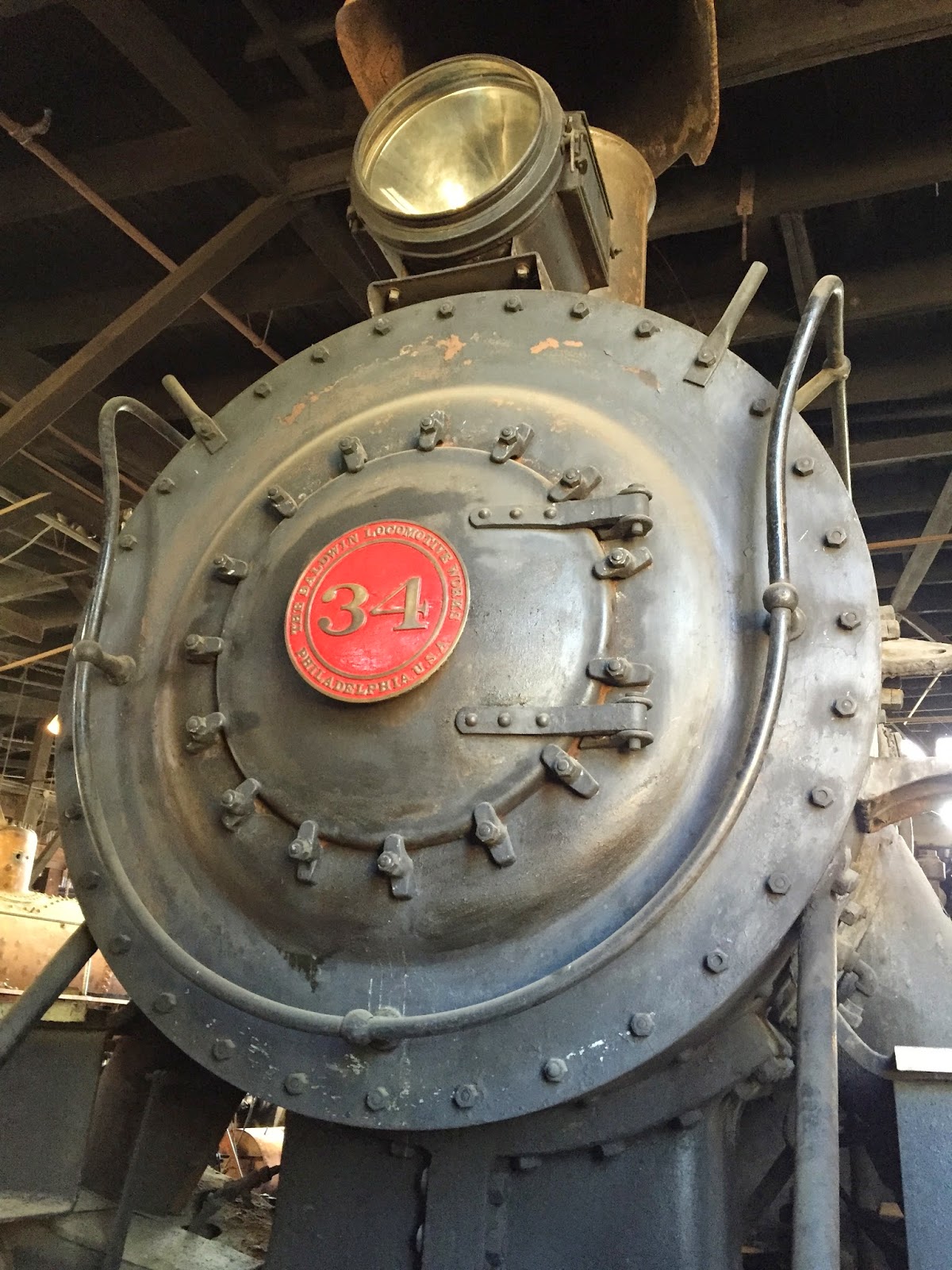
We had a tour and train ride in Jamestown, CA at the rail museum.  Sadly, they only run the steam engine on Saturdays and we were there on Sunday. However, the tour took us through the round house and our guide shared the history of several of the engines the museum owns. Old number 3 is a movie and TV star, having played a starring role in Petticoat Junction, the Wild, Wild West and Back to the Future III, to name a few.


Yeah, I know it says "34" on the nose of the engine, but it really is #3. It is one of those movie things, just like actors have a character name in movies and TV.

Here is a bit of video I found online, showing what we missed.


I have to admit, even I would have enjoyed the ride a bit more with all of that clanging and hissing! However, I did find it very interesting that a 'fire car' had to follow our train up and down the track. Although it isn't likely, the State requires the fire car to make sure that any possible fire ignited by sparks is taken care of quickly.


The other thing I found interesting in Jamestown was seeing a steam locomotive without the outer covering. This engine is being painstakingly restored to make it an operable locomotive. Each of the holes on the side have pipes (or will have) in them. The pipes carry excess heat out of the compartment so the tank, which holds hot water, doesn't crack. Longer pipes run front to back inside the water tank. They carry hot air from the fire box (located behind the tank) through the front tank to heat the water and make the steam that drives the pistons. 


I guess since I was not endowed with that "Y" chromosome, I never thought about how the steam locomotive actually heated the water. 

The Railtown visit in the roundhouse was interesting as it is, and has been, an authentic, working roundhouse. It has several working locomotives and more being restored. There are huge tools, nuts and bolts, and lots of dirt and grease all over the place. The antithesis of this is the California State Railroad Museum. (I love that word!) This museum also has "rolling stock" but all of the locomotives and cars exhibited in the museum have been painstakingly restored. 


Visitors can walk among the cars inside the huge building. There are a few cars that visitors can walk through. I enjoyed seeing the mail car, where US Postal employees would sort mail as the train chugged across country. Another favorite of mine was the Pullman sleeper car, circa 1930's. The museum has rigged the car to sway and lurch as if the train were moving down the tracks, and a docent, dressed as a porter, is there to answer questions and point out features of the car. Next to the sleeper car is a dining car. I was fascinated by the place settings on each table, showing china from different railroad lines. But then again, that would appeal to me since I am somewhat of a 'chinaholic'!


The exhibit also included a number of menus from different railroad lines. It struck me how basic the meal offerings were, compared to the elaborate descriptions of dishes on today's menus.


Skip forward a few days….

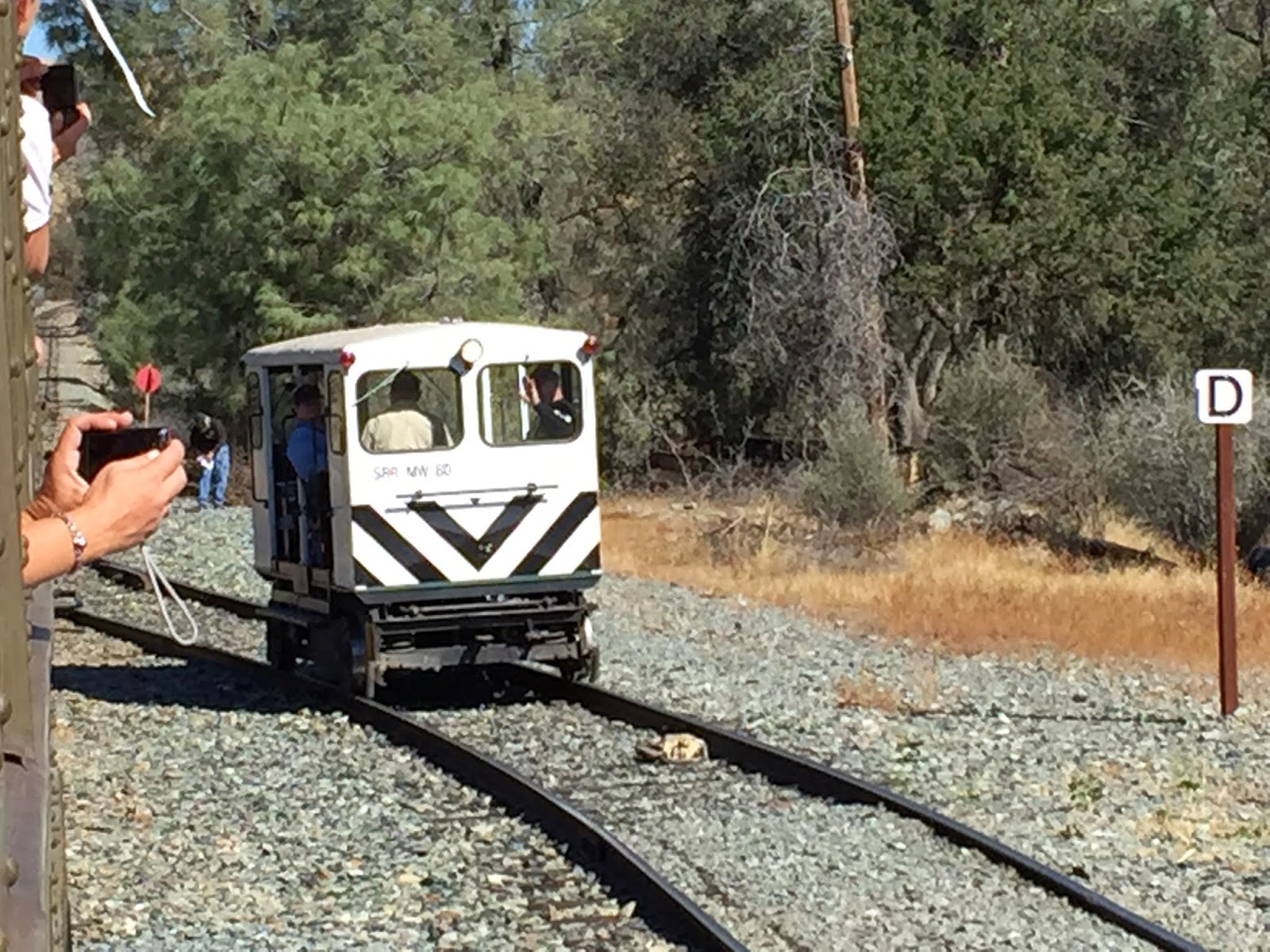
We Dreamers were on our way into Yosemite when Mr. Dreaming noticed a sign, and took an immediate detour, to the Sugar Pine Railroad. Once again, we missed the opportunity for a steam locomotive trip (wrong day of the week), but we did get to experience something totally different. We took a "Jenny Car" ride. Jenny cars, powered by Model "A" engines, were used for maintenance of rail lines. The Sugar Pine rail company has refitted the cars to take a few passengers on a loop following an old logging line. Along the way, our 'driver' enlightened us regarding the history of logging in the area.


Although I thoroughly enjoyed our tours of railroad museums, and our rides on old trains, I was more than ready to move on….


Friday, April 4, 2014

Take the Last Train


We didn't go to Clarksville, but it was close:


And, we did take a train:

(If you 'biggify' the photo you can see the train 
going around the bend waayyy upahead!)


Clarkdale was founded by William Clark in 1912. It was one of America's early planned communities. Clark purchased the copper mines in nearby Jerome, AZ, and needed an area to smelt the ore. He created the community of Clarkdale with subsidized company housing, on streets laid out along a grid with sewer, water and power. Community buildings, including a school, administrative center, recreational and cultural facilities were included and built according to the master plan. Clarkdale was situated along the Verde River, along which ran a railroad that could be used to transport copper throughout the US. 

Slag heap that remains from smelting ore in Clarkdale

That rail line still exists today and the Verde Canyon Railroad offers daily trips between Clarkdale and Perkinsville. Perkinsville was established by the Perkins family in the early 1900's. The stop on the route from Clarkdale provided water for steam engines. Limestone was also quarried nearby, and was used in the smelting process. Today the railroad depot in the 'town' is boarded up, the water tower was destroyed in filming "How the West was Won" in the 1960's, but trains still come by with freight and curious passengers. 

Perkinsville, AZ

Scenes from the Verde Canyon Railroad:


Santa Fe

We had a beautiful day in Santa Fe.  We made a quick stop at the Cathedral of St Francis of Assisi.  It was awe inspiring to see "La Co...